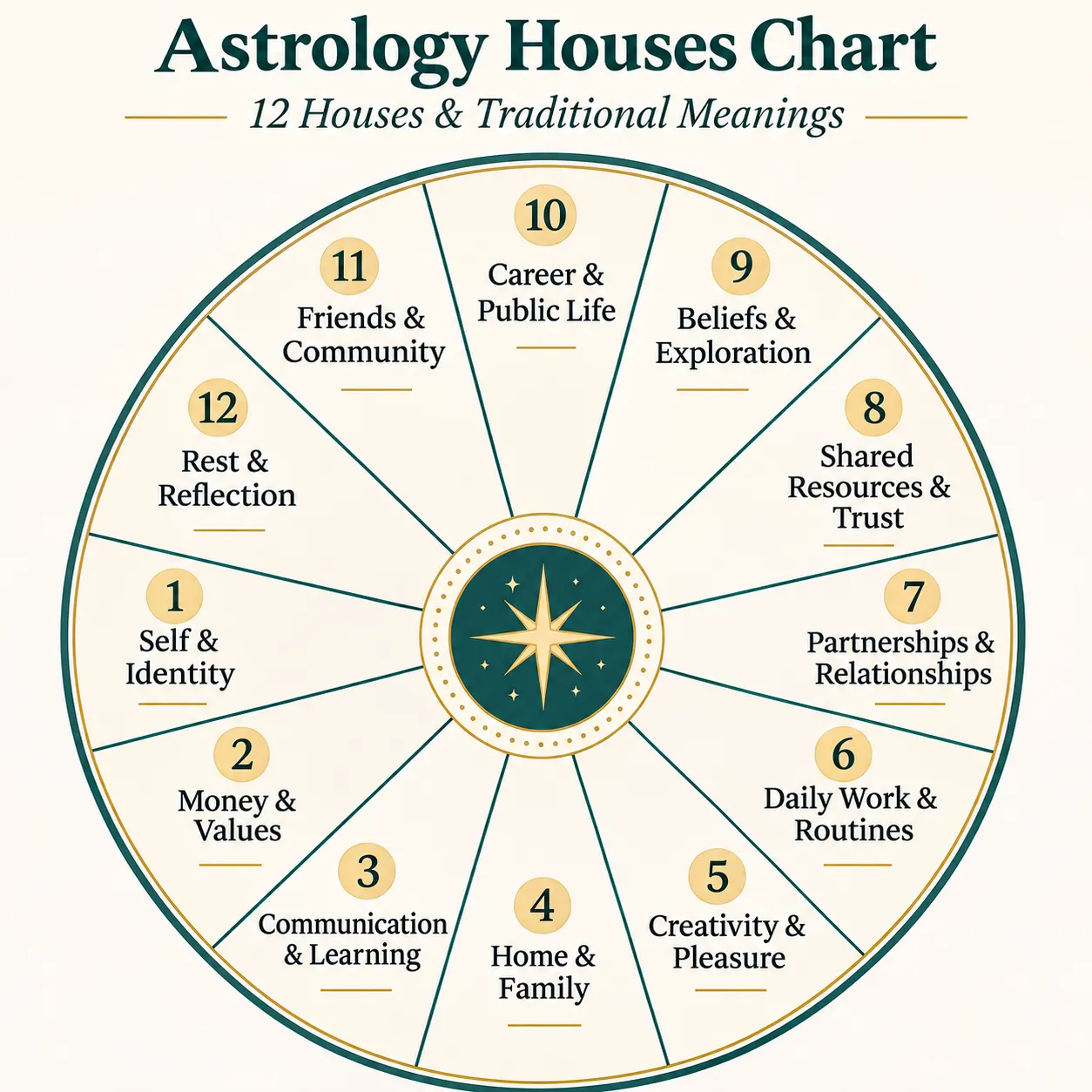
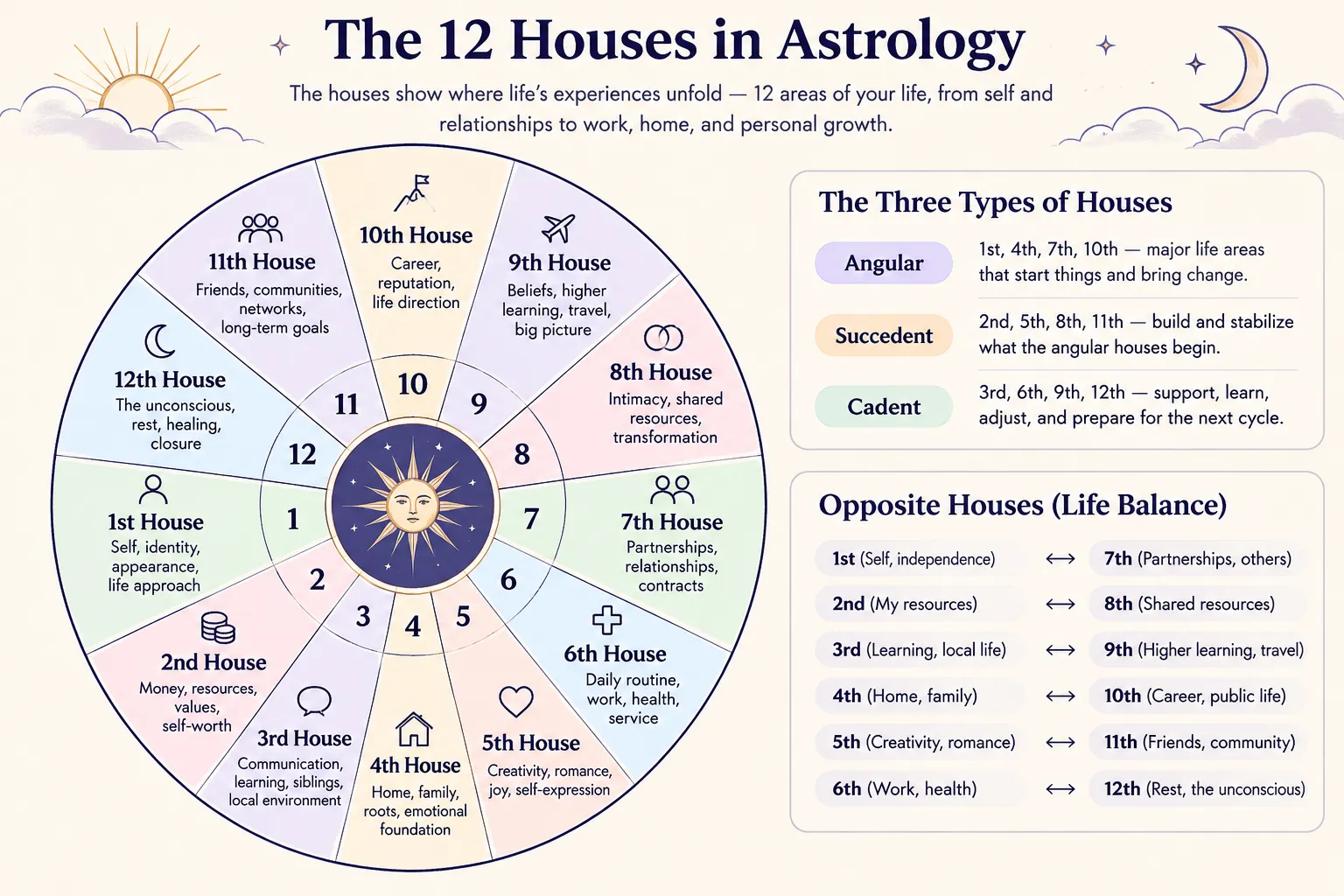
Each house answers a different question about a life area. The summaries below are about how to read the structureof the wheel. Use a personal chart to discover which zodiac signs and planets are actually present in each house.
1st House
Self & Identity
Key themes: Identity, appearance, first impressions.
The first house is the part of the chart most closely connected with the Ascendant. It describes self-presentation and how you begin new experiences in traditional astrology. When reading a personal chart, first locate the rising sign and its exact degree, then see which planets occupy the first house. The sign at its cusp depends on birth details—it is not automatically Aries.
Opposite: 7th House · House type: angular
2nd House
Money & Values
Key themes: Personal resources, possessions, priorities.
The second house is traditionally linked with what you own and value. Its symbolic topics include personal resources, material security, and the choices you make around your belongings. Look for the cusp sign, any planets in the house, and the traditional ruler of that sign. Its meaning is not a prediction of wealth or future earnings.
Opposite: 8th House · House type: succedent
3rd House
Communication & Learning
Key themes: Conversation, siblings, local life.
The third house emphasizes everyday communication, practical learning, nearby journeys and familiar connections. In a chart diagram it sits opposite the ninth house, which considers broader beliefs and horizons. A personal reading adds the sign on this house's cusp, its ruler and any planets located here.
Opposite: 9th House · House type: cadent
4th House
Home & Family
Key themes: Family, roots, private foundations.
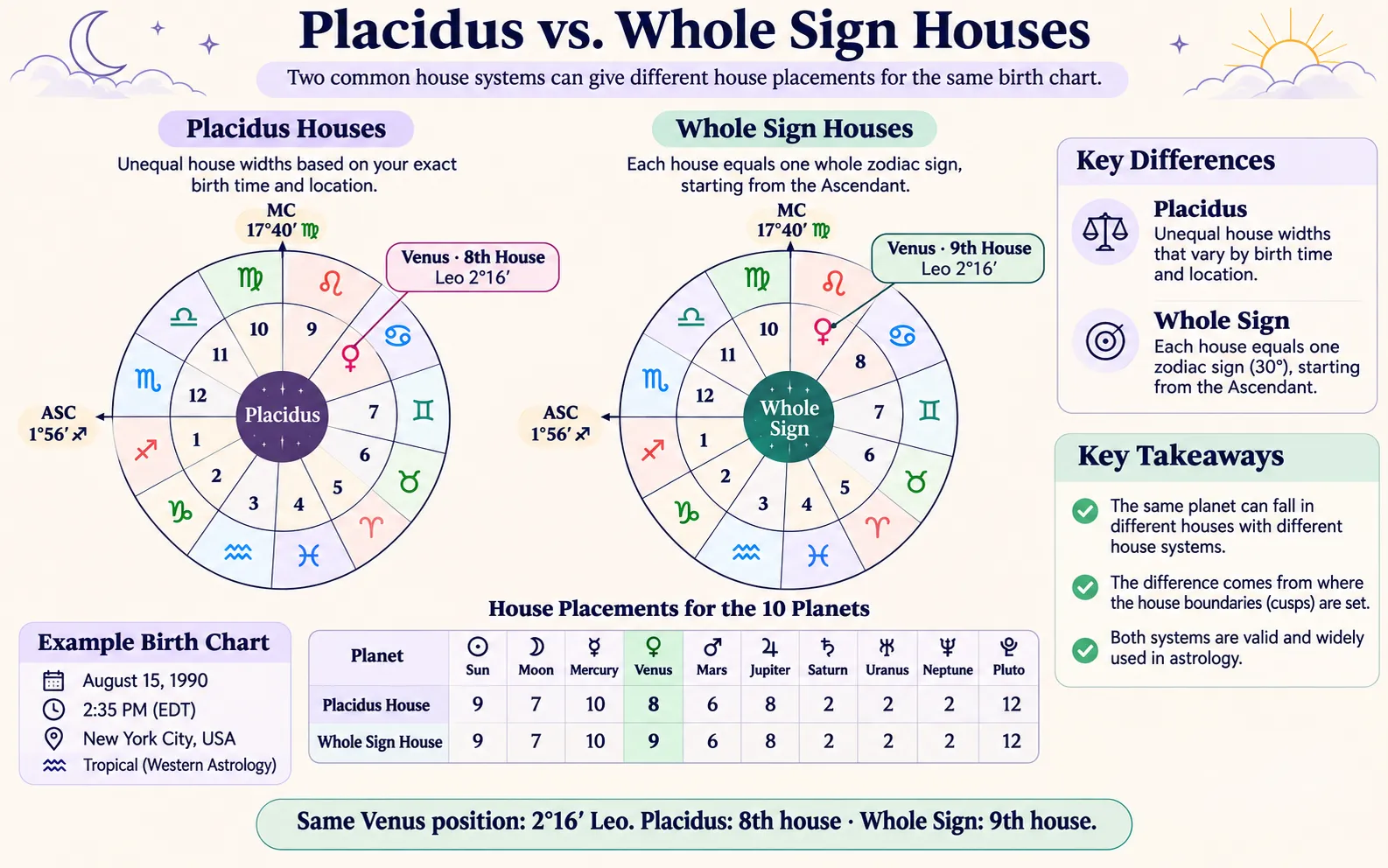
The fourth house traditionally represents home, family, a sense of belonging and private foundations. Its opposite is the tenth house of public roles and reputation. In Placidus, the IC angle is at the fourth-house cusp; in Whole Sign it can appear inside another house. A generic diagram is not enough to tell you your own fourth-house sign.
Opposite: 10th House · House type: angular
5th House
Creativity & Pleasure
Key themes: Creative expression, play, enjoyment.
The fifth house is associated with creative pursuits, enjoyable activities, romance and play. Across the wheel, the eleventh house looks toward friendships and collective goals. Planets in the fifth can add traditional symbolic themes to personal enjoyment, but do not predict romantic events or having children.
Opposite: 11th House · House type: succedent
6th House
Daily Work & Routines
Key themes: Daily tasks, habits, service.
The sixth house represents the activities and responsibilities of everyday life: routines, practical work and service. It faces the twelfth house, with its emphasis on solitude and rest. Its placement does not establish anything about someone's health. For a specific birth chart, consider the house cusp and ruler as well as any planets.
Opposite: 12th House · House type: cadent
7th House
Partnerships & Relationships
Key themes: One-to-one partnerships, agreements.
The seventh house is opposite the first. Where the first emphasizes the self, the seventh looks at one-to-one connections, agreements and committed relationships. Its cusp is the Descendant in Placidus. The sign there is not automatically Libra. Check the calculated cusp sign and its ruler when reading your own chart rather than trying to predict a future partner.
Opposite: 1st House · House type: angular
Learn about your own 7th House8th House
Shared Resources & Trust
Key themes: Shared money, trust, intimacy.
The eighth house is traditionally linked with shared finances, obligations, trust and intimacy. Its opposite is the second house of personal resources and values. This contrast helps explain the house pair visually. A planet such as Venus can fall in the eighth under one house system and the ninth under another without moving in the zodiac.
Opposite: 2nd House · House type: succedent
9th House
Beliefs & Exploration
Key themes: Education, worldviews, long journeys.
The ninth house describes broader learning, philosophy, beliefs and exploration. It faces the third house, which concerns everyday communication and local knowledge. A ninth-house planet brings that planet's traditional themes into this wider field. The sign at the beginning of the house depends on the chart, not on the house number.
Opposite: 3rd House · House type: cadent
10th House
Career & Public Life
Key themes: Public role, vocation, reputation.
The tenth house focuses on work in the public sphere, reputation, responsibility and vocation. It stands opposite the fourth house of home and private foundations. The Midheaven (MC) is a separately calculated angle: in Whole Sign it may fall outside the tenth house, so the two should not always be treated as identical.
Opposite: 4th House · House type: angular
11th House
Friends & Community
Key themes: Friendships, groups, shared hopes.
The eleventh house concerns friendships, groups, networks and goals pursued with other people. It is opposite the fifth house of personal creativity and pleasure. The contrast is useful when exploring individual expression alongside social participation. You can learn this theme from a diagram without knowing any personal birth details.
Opposite: 5th House · House type: succedent
12th House
Rest & Reflection
Key themes: Solitude, reflection, private time.
The twelfth house is linked with private experiences, solitude, rest and matters that may not be visible to others. Opposite it, the sixth house concerns everyday activities and duties. The pair can be considered as a balance between work and rest. An empty twelfth house is common and does not signify a problem or misfortune.
Opposite: 6th House · House type: cadent